

© ES-CON JAPAN Ltd.
Sustainability
Commitment to decarbonization
Initiatives for a Decarbonized Society
Reducing greenhouse gas emissions
In our Long-Term Vision 2030, ES-CON JAPAN group has set "promoting a decarbonized society" as one of the key themes (materiality) for sustainability management. We will achieve a reduction in greenhouse gas emissions by promoting the development of ZEH-M and utilizing non-fossil fuel certificates.
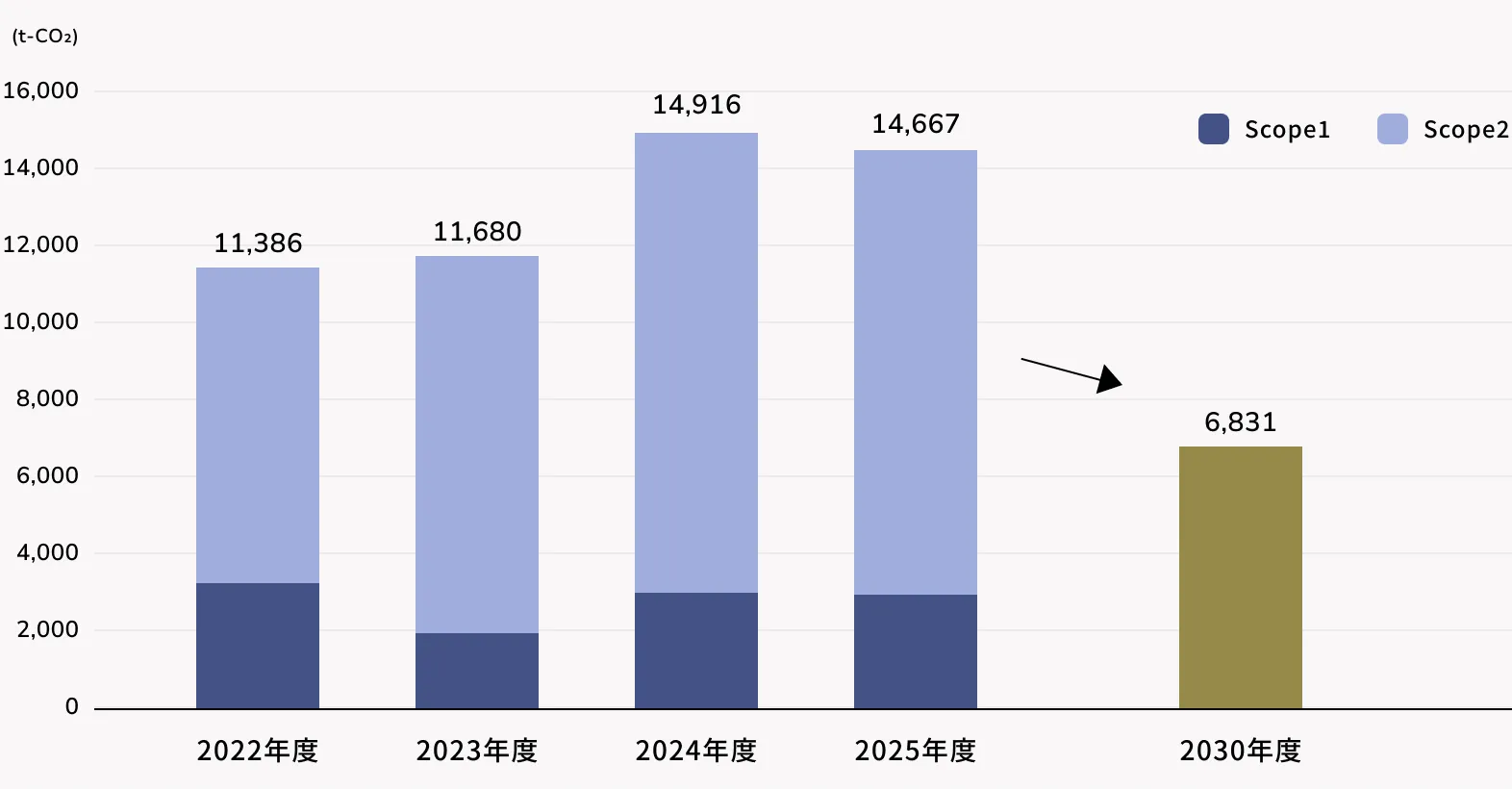
ES-CON JAPAN Group-wide decarbonization targets
Greenhouse gas emissions for the entire Group※of
40% reduction by fiscal 2030
(Compared to fiscal 2022)*Scope 1 and 2 are covered, Scope 3 will be considered in the future
Quantitative data (greenhouse gas emissions)
Unit: t-CO2
|
FY2022 (base year)
January 2022~December 2022
|
FY2023※
April 2023~March 2024
|
FY2024
April 2024~March 2025
|
FY2025
April 2025~March 2026
|
FY2030
(Target year) April 2030~March 2031 |
|
|---|---|---|---|---|---|
| Scope 1 | 3,230 | 1,977 | 2,839 | 2,645 | |
| Scope 2 | 8,155 | 9,703 | 12,077 | 12,022 | |
| Subtotal (Scope1+2) | 11,386 | 11,680 | 14,916 | 14,667 | |
| Reduction rate compared to base year | +2.6% | +31.0% | +28.8% | -40.0% | |
| Scope 3 | 806,238 | 671,278 | 863,731 | 723,171 |
※The figures for fiscal years 2022 and 2023 represent ES-CON JAPAN Ltd. 's individual figures.
※ES-CON JAPAN Ltd. Scope 1 and Scope 2 emissions (FY2022-2024) are included in Chubu Electric Power Group's Scope 1 and Scope 2 emissions, and Chubu Electric Power Group has obtained third-party assurance for its Scope 1 and Scope 2 emissions.
Scope 1 and 2 reduction image
Information Disclosure
In June 2022, ES-CON JAPAN expressed our support for TCFD recommendations and disclosed information based on TCFD 's recommended disclosure framework (governance, strategy, risk management, metrics and targets related to climate change risks and opportunities).
Going forward, based on the contents of this disclosure, we will actively work towards realizing a sustainable society.
※
TCFD (Task Force on Climate-related Financial Disclosures) was established in 2015 by the Financial Stability Board (FSB) at the request of the G20. It evaluates the financial impact of climate change risks and opportunities on business operations and encourages companies to disclose information on "governance," "strategy," "risk management," and "metrics and targets."